
Introduction
Business automation is entering a new phase.
For years, companies have used software to automate repetitive tasks such as sending emails, updating records, processing forms, generating invoices, and moving information between systems. These tools improved efficiency, but most traditional automation depended on fixed rules.
If something unexpected happened, a person usually had to step in.
In 2026, AI agents are changing business automation by allowing software to do more than simply follow predefined instructions. AI agents can understand a goal, gather information, determine what steps are needed, use connected tools, take approved actions, and adjust when conditions change.
Instead of telling software exactly what to do at every step, businesses can increasingly define the outcome they want and allow an AI agent to help manage the process.
This shift from rule-based automation to goal-driven automation is one of the most important developments happening in business technology today.
Gartner previously forecast that 40% of enterprise applications would include task-specific AI agents by the end of 2026, compared with less than 5% when the forecast was published in 2025. Gartner also forecasts worldwide AI spending to reach approximately $2.59 trillion in 2026, a 47% year-over-year increase, with agentic workflows contributing to growing AI usage across enterprise software.
So what exactly are AI agents, and how are they changing the way businesses operate?
What Are AI Agents?
An AI agent is a software system designed to work toward a specific goal with a degree of independence.
Unlike a standard chatbot that mainly responds to questions, an AI agent can perform actions.
IBM describes AI agents as systems that autonomously perform tasks by creating workflows and using available tools. These tools can include databases, APIs, business applications, search systems, and even other AI agents.
For example, imagine a business receives a new sales inquiry. A traditional chatbot might simply acknowledge the inquiry and say that a sales representative will follow up. An AI sales agent could potentially:
- Read the customer’s inquiry.
- Identify what product or service they need.
- Check the company’s CRM for existing information.
- Research or retrieve relevant account details.
- Qualify the lead according to predefined rules.
- Prepare a personalized response.
- Update the CRM.
- Schedule a follow-up task.
- Escalate the opportunity to a salesperson when human involvement is required.
That ability to move from answering to acting is what makes AI agents particularly important for business automation.
AI Agents vs. Traditional Automation
Traditional automation is still extremely useful. The difference is that it usually works best when the process is predictable.
Consider a simple workflow: when a customer submits a form, create a CRM contact and send a confirmation email. The steps are known in advance.
AI agents are more useful when the workflow includes changing information, unstructured data, decisions, or exceptions.
| Traditional Automation | AI Agent Automation |
|---|---|
| Follows predefined rules | Works toward defined goals |
| Requires fixed workflows | Can determine the next appropriate step |
| Best for predictable processes | Useful for more complex or variable processes |
| Handles structured information well | Can work with structured and unstructured information |
| Exceptions often require human intervention | Can evaluate some exceptions within defined limits |
| Executes specific actions | Can coordinate multiple actions and tools |
| Limited context awareness | Can use contextual information to guide decisions |
AI agents do not necessarily replace traditional automation. In many cases, the most effective system combines the two. Reliable, predictable tasks can continue using conventional automation, while AI handles areas requiring interpretation, reasoning, or flexible decision-making.
How AI Agents Are Changing Business Automation in 2026
The biggest change is not simply that AI is getting better at generating text. It is that AI systems can increasingly participate in workflows and take action across business applications.
Here are some of the areas where this change is becoming most visible.
1. Customer Service Is Moving From Answering Questions to Solving Problems
Customer service was one of the earliest areas to adopt chatbots. Traditional bots could answer questions such as business hours, order status, password resets, or return policies.
AI agents can take this much further. A customer service agent could identify the customer’s issue, retrieve account information, check order status, search a knowledge base, update a support ticket, recommend a solution, and escalate the conversation if the problem requires human judgment.
Instead of only reducing the number of questions employees answer, businesses can automate larger portions of the support resolution process. This can help companies provide faster responses while allowing support teams to spend more time on difficult or sensitive customer problems.
2. Sales Teams Can Automate More of the Lead Management Process
Sales teams often spend significant time on administrative work. AI agents can potentially assist with prospect research, lead enrichment, inquiry review, lead qualification, CRM updates, meeting summaries, personalized follow-ups, scheduling, and identifying opportunities requiring attention.
Consider an incoming lead from a company’s website. An AI agent could analyze the request, compare it with predefined qualification criteria, retrieve relevant company information, update the CRM, prepare a recommended response, and notify the appropriate sales representative.
The salesperson remains responsible for building relationships and making important business decisions, while the AI handles more of the repetitive coordination around the sales process.
3. Finance Teams Can Automate More Than Data Entry
Finance departments have used automation for years, but many processes still require employees to review documents and compare information manually.
AI agents can help with workflows involving invoices, purchase orders, expense reports, and financial documents. An invoice-processing agent could read an incoming invoice, extract relevant information, find the related purchase order, compare quantities and prices, identify discrepancies, update the appropriate system, route unusual cases for approval, and maintain an activity log.
The goal is not necessarily to remove employees from financial processes. Instead, AI agents can handle routine cases while sending exceptions and higher-risk decisions to employees.
4. Marketing Automation Is Becoming More Context-Aware
Traditional marketing automation often relies on predefined sequences. For example: a customer downloads a guide, waits two days, receives an email, waits three more days, and receives another email.
AI agents can make these workflows more adaptive. An AI marketing agent could analyze customer activity, identify interests, retrieve relevant content, personalize communication, and recommend the next action based on real-time behavior.
This could support lead nurturing, audience research, content personalization, campaign reporting, customer segmentation, social media monitoring, and marketing data analysis.
Gartner predicts that by 2028, 60% of brands will use agentic AI to support more streamlined one-to-one customer interactions across marketing, sales, and support.
5. IT Operations Can Become More Proactive
IT departments constantly handle alerts, support requests, system monitoring, access issues, and routine maintenance. AI agents can help analyze these signals and coordinate responses.
For example, an IT agent could detect an unusual system alert, review system logs, identify possible causes, search internal documentation, run approved diagnostic actions, recommend or execute a predefined solution, and escalate the incident if the issue remains unresolved.
This can reduce the time IT teams spend investigating repetitive incidents. AI coding agents are also expanding across the software development lifecycle, moving beyond simple code completion toward planning, code creation, testing, reviewing, and other development activities.
6. Internal Business Operations Can Be Connected
One of the biggest opportunities for AI agents for business automation is connecting systems that employees currently manage manually.
Many businesses use separate platforms for CRM, accounting, project management, customer support, inventory, email, documents, and analytics. Employees often become the connection between those systems—downloading information from one application, interpreting it, entering it into another system, sending a message, creating a task, and repeating the process.
An AI agent can potentially coordinate several of these actions through APIs and integrations. This means automation can move beyond individual tasks toward end-to-end workflows.
7. Businesses Can Automate Unstructured Work
Traditional automation performs best with structured information such as database fields, form submissions, and spreadsheets. But a large amount of business information is unstructured, including emails, PDFs, customer messages, contracts, support tickets, meeting notes, and reports.
AI agents can interpret this information before deciding what action should happen next. This dramatically increases the number of processes businesses can consider automating.
A procurement agent, for example, might read a supplier email, understand the requested change, compare the information with existing records, update a workflow, and notify the appropriate employee. Previously, a person would often be required simply to understand what the email meant.
Key Benefits of AI Agents for Business Automation
Reduced Repetitive Work: Employees can spend less time copying information, checking systems, preparing routine reports, and completing repetitive administrative steps.
Faster Processes: AI agents can operate across multiple systems without waiting for someone to manually complete every stage of a workflow.
Better Scalability: As workload increases, organizations may be able to process more routine requests without increasing administrative workload at the same rate.
More Consistent Processes: Agents can follow defined business policies and procedures consistently, while unusual situations can be routed to employees.
24/7 Availability: Certain automated workflows can continue outside normal business hours, particularly customer service, monitoring, and data-processing activities.
Better Use of Business Data: AI agents can retrieve and combine information from different sources, helping employees access useful context without manually searching several applications.
AI Agents Do Not Mean Fully Autonomous Businesses
There is significant excitement around agentic AI, but companies should avoid assuming that every process should become autonomous.
An AI agent can make mistakes. It can misunderstand information, use incorrect data, select an inappropriate action, or encounter situations outside the conditions for which it was designed.
That is why human oversight remains essential, particularly for actions involving:
- Financial transactions
- Legal decisions
- Sensitive customer data
- Employee decisions
- Security permissions
- High-value purchases
- Irreversible system changes
The objective should not be maximum autonomy. The objective should be the right level of autonomy for each workflow.
The Security and Governance Challenge
AI agents create new security considerations because they can do more than generate information—they may have permission to take action.
If an AI system can access email, CRM records, payment information, internal databases, or administrative tools, organizations need strong controls around that access.
Important safeguards include:
- Role-based permissions
- Minimum necessary system access
- Human approval for sensitive actions
- Audit logs
- Agent monitoring
- Data privacy controls
- Authentication and identity management
- Testing before production deployment
- Clear escalation rules
Governance is becoming particularly important as companies deploy more AI agents. Gartner predicts that by 2027, 40% of enterprises will demote or decommission autonomous AI agents because of governance gaps identified after production incidents.
The message for businesses is simple: implementing an AI agent is not only an AI project. It is also a data, security, integration, process, and governance project.
How Businesses Should Start With AI Agents
Companies do not need to automate everything at once. A smaller, measurable implementation is usually a better starting point.
Step 1: Identify Repetitive Work
Look for processes that consume significant employee time, such as repetitive customer inquiries, manual CRM updates, document processing, report generation, lead research, data entry, or internal information searches.
Step 2: Map the Existing Workflow
Understand exactly how the task currently works. Document the input, decisions, systems, actions, approvals, and final outcome. You cannot effectively automate a process that is poorly understood.
Step 3: Choose a Low-Risk Use Case
The first agent should ideally handle a process that is frequent, time-consuming, easy to measure, relatively low risk, based on accessible data, and easy for employees to verify.
Step 4: Connect the Required Systems
An agent becomes much more useful when it can access the tools needed to complete its task. This might include integrations with CRM systems, databases, internal software, email platforms, cloud services, or business APIs.
Step 5: Define Guardrails
Clearly specify what the agent can access, what actions it can perform, when human approval is required, what happens when confidence is low, and what information must be logged.
Step 6: Measure the Results
Do not measure success by whether the AI agent appears impressive. Measure actual business outcomes such as time saved, cost per transaction, resolution time, error rate, manually completed steps, customer response time, employee productivity, and the percentage of cases requiring human intervention.
Step 7: Expand Gradually
Once one workflow operates reliably, businesses can explore additional use cases or connect multiple specialized agents.
From Single Agents to Multi-Agent Systems
Another trend to watch is the rise of multi-agent systems.
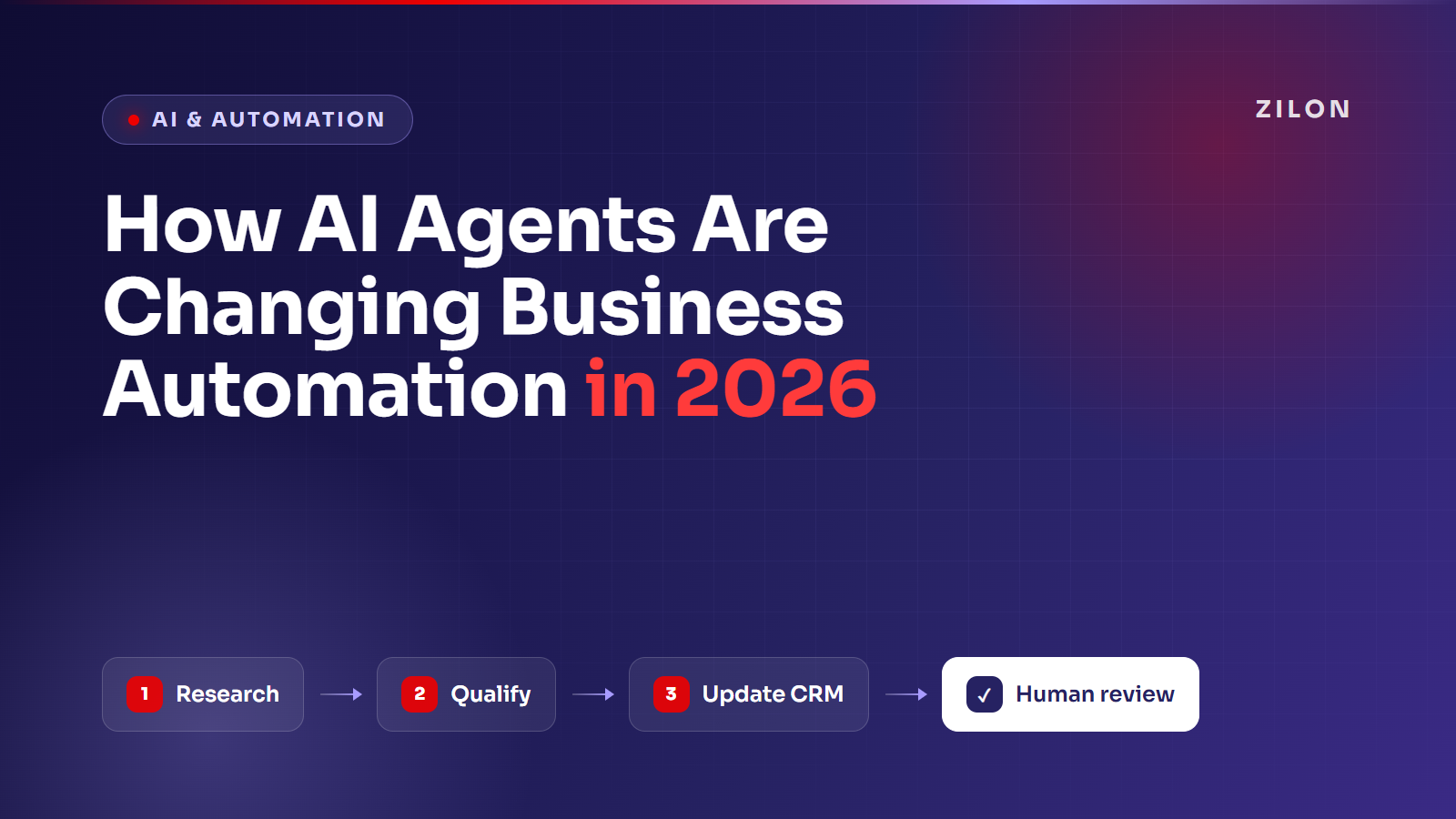
Instead of asking one AI agent to handle an entire process, businesses can use several specialized agents that work together. For example, a sales workflow might contain: Research Agent → Qualification Agent → CRM Agent → Communication Agent → Human Sales Representative.
Each agent performs a specific role. This model can make complex automation easier to manage because responsibilities can be separated and controlled.
However, multi-agent systems also increase integration, monitoring, and governance complexity. More agents do not automatically mean better automation. Businesses should add complexity only when it creates measurable value.
What Will Business Automation Look Like Beyond 2026?
The future of business automation is likely to involve a combination of people, AI agents, traditional software, and automated workflows.
People will continue to handle areas requiring judgment, strategy, relationships, creativity, accountability, and complex decision-making. Traditional automation will continue handling predictable processes. AI agents will increasingly operate between these layers—interpreting information, coordinating applications, completing multi-step tasks, and escalating situations that require human attention.
Gartner has suggested that enterprise software could increasingly move toward outcome-focused workflows in which intelligent systems execute tasks across applications while employees supervise the results.
The user interface may therefore become less important in some workflows. Instead of opening five applications and manually completing ten steps, an employee might simply define the desired result while an agent coordinates the necessary systems behind the scenes.
Final Thoughts
AI agents are changing business automation in 2026 by moving automation from fixed instructions toward intelligent, goal-driven workflows.
They can help businesses interpret information, coordinate multiple systems, handle repetitive tasks, and complete processes that previously required constant human involvement.
But successful AI automation is not simply about installing an AI tool. Businesses need the right processes, integrations, data, security controls, human oversight, and measurable objectives.
Companies that start with practical problems instead of chasing AI trends are more likely to create useful automation that improves everyday operations.
The most important question is no longer, “What can AI generate for us?” It is becoming, “What work can AI safely help us complete?”
As AI agents continue to evolve, that question will play an increasingly important role in how businesses design their software, workflows, and digital operations.
Looking to explore AI-powered automation for your business? Contact Zilon to discuss how technology can help simplify workflows, connect systems, and support your digital growth.
Frequently Asked Questions
What is an AI agent in business automation?
An AI agent is software that can work toward a defined business goal, use connected tools and information, determine appropriate steps, and perform approved actions with less step-by-step human input than traditional automation.
How are AI agents different from chatbots?
A chatbot primarily communicates with users and answers questions. An AI agent can go further by using tools, retrieving information, making decisions within defined limits, and taking actions across business systems.
What business processes can AI agents automate?
AI agents can support customer service, lead management, sales administration, document processing, finance operations, IT support, marketing workflows, reporting, internal knowledge retrieval, and other multi-step processes.
Are AI agents safe for businesses?
They can be used safely when businesses implement proper permissions, security controls, testing, monitoring, audit logs, and human approval for sensitive actions. Giving an agent unnecessary system access increases risk.
Will AI agents replace employees?
AI agents are more useful when viewed as tools for automating repetitive work rather than universal employee replacements. Human judgment remains important for complex, sensitive, strategic, and high-risk decisions.
Can small businesses use AI agents?
Yes. Small businesses can start with focused use cases such as customer inquiry management, lead qualification, document processing, reporting, scheduling, or internal administrative workflows instead of implementing large autonomous systems.
What is the best way to start using AI agents?
Start with one repetitive, measurable, low-risk workflow. Map the existing process, connect only the required systems, define permissions and approval rules, monitor the results, and expand automation only after the initial use case proves reliable.